Scorpio – Fortune Estates
India's First Net Energy Positive Affordable Housing Project
IGBC Green Homes – Platinum
Pune, Maharashtra
24
Apartments
41.28 kWp
Solar Installed
66,000 kWh
Generated / Year
IGBC Platinum Rated Building
Green Rating
The Problem
Green buildings that weren't green
for the people living in them.
Residential buildings in India faced a fundamental barrier: rooftop solar could only power common areas, leaving every individual apartment entirely dependent on the grid. Residents of green-certified buildings continued to pay full electricity bills, and there was no technology to equitably meter and distribute solar energy to each homeowner in a multi-unit building, which made green certification meaningless at the household level.
42%
of global CO₂ from real estate
10M+
affordable homes needed in India by 2030
70%
of India's 2030 building stock is yet to be built
The Building
Scorpio, Fortune Estates at a glance
Site Area
1,204 sq m
Built-up Area
2,651 sq m
Floors
Stilt + 6 floors
Unit Type
2-BHK · 900 sq ft
Completed
2019
Total Units
24
Developer
Oricon Developers
Technology
Protostar Technologies
On Risk & Conviction
Oricon bore the full construction cost without any presales. Because Scorpio's features were entirely experimental and had never been tested at scale before, RERA required waiting for the Completion Certificate before a single unit could be sold. Both father and son proceeded on conviction alone.
The Solar Story
Solar for every apartment, not just the lobby.
The Rooftop System
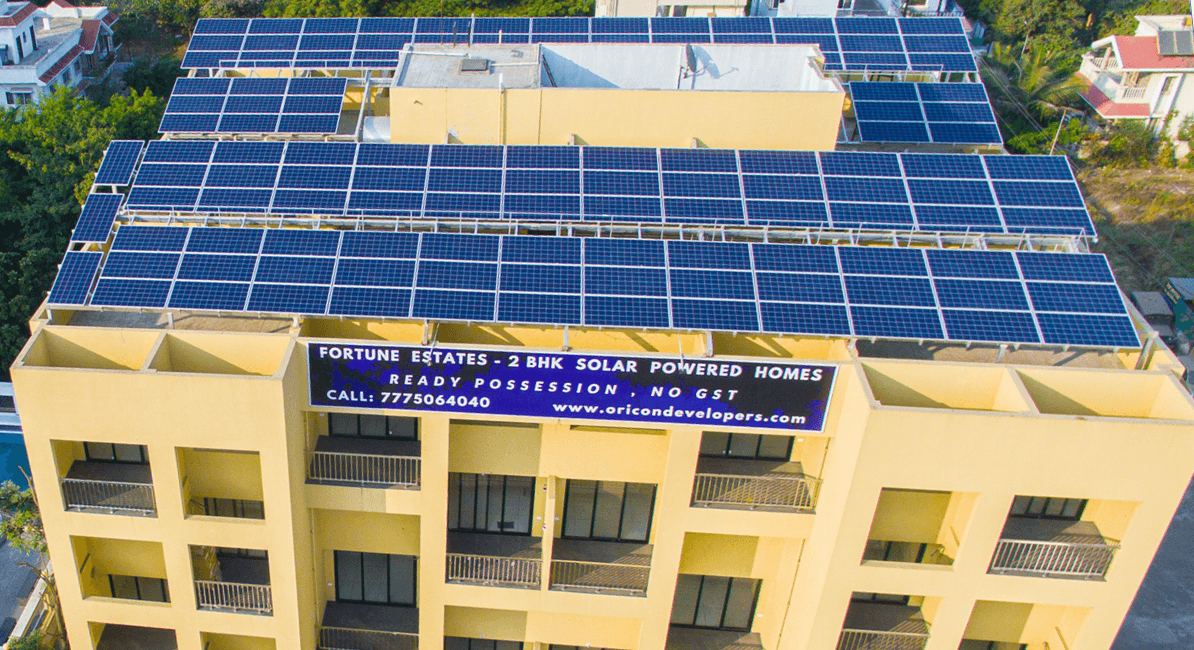
A 41.28 kWp solar system covers the entire rooftop and generates 66,000 units (kWh) of clean electricity every year. That is enough to run every common area and still give each apartment 100 free units a month.
Raised on a framework, not flat-mounted.
Most builders mount panels directly on the terrace floor. The panels at Scorpio were raised on a framework instead. This created usable terrace space for residents, protected the waterproofing from direct sun, and let air flow beneath the panels so they perform better.
Grid-connected with net metering carry-forward.
Maharashtra's rules allow surplus solar to be carried forward within the same year. Extra power generated in peak summer months builds up as credit, which the building draws down during the monsoon when cloud cover cuts generation to 40–50% of normal.
The SPDU: The Invention That Made It Possible
Smart Power Distribution Unit · Patented
No smart meter available anywhere in India could simultaneously give individual apartments their allocated share of solar energy while keeping them seamlessly connected to the grid as a fallback. Rahul went back to the drawing board: designed the SPDU from first principles, built a prototype, and tested it in his own home. After debugging every edge case, he filed a patent. A manufacturing partnership was established to produce the units at scale, which were then installed in the ground-floor meter room serving all 24 flats. Each apartment gets 100 free solar units per month. When the quota is consumed, the system switches to grid power silently, with no interruption. Some residents ended up drawing only 10–15 additional grid units a month.
100
free units/month
per apartment from solar
10–15
grid units
some residents' total monthly top-up
24
apartments
individually metered and managed
Hot Water: Done Right
Three ways of heating water existed. Only one worked all year round without pushing bills back up. In the cards below, COP is simply an efficiency score. It tells you how many units of useful heat you get for every one unit of electricity you put in.
Electric Geyser
High running cost every month. With a COP of 0.95, nearly all the electricity you pay for goes into making heat the hard way. High carbon footprint.
Solar Water Heater
Worst when you need it most. Cloud cover in the monsoon and winter cuts output sharply, forcing residents back to electric geysers.
Heat Pump
The Engineering Insight
The cold exhaust from the heat pump was rerouted into the stairwell and floor landings, passively cooling the entire building's interior.
A standard heat pump runs at COP 3.5. By connecting it to rooftop solar and rerouting its cooling byproduct through the building, Scorpio reached an effective COP of 6.0. Every 1 unit of electricity consumed produces 3.5 units of heat and 2.5 units of cooling at the same time. The 3,500L tank meets the building's entire 2,880L daily hot water demand, around the clock.
1 unit in → 6 units of work out
Beyond Solar
The full engineering picture
Solar was the headline. These are the quieter decisions that made Scorpio genuinely net positive across energy, water, and materials.
Passive Design
96% of roof area reflective-coated
Double walls on the east and west faces block afternoon heat gain before it enters the building. 96% of roof area is coated with reflective materials; 100% of non-roof area uses high-SRI surfaces to counter the urban heat island effect. 15% of the site was reserved as green space, with natural topography and soil permeability fully retained.
EV Charging Since 2016
Every parking lot pre-wired
In 2016–17, when EVs were still a fringe concept in India, 15-ampere sockets were pre-wired at every single parking lot, with clean concealed installation and no exposed conduits. Rahul was driving a Mahindra e2o at the time. Residents are now buying EVs because the infrastructure was already there when they needed it.
Energy Recovery
80–90% reduction in common area lighting consumption
Motion sensors on every common area light cut consumption by 80–90%. The elevator is fitted with a regenerative dynamo that converts the kinetic energy of a descending cab back into usable electricity, feeding it directly into the building's electrical infrastructure.
Water: Every Drop Accounted For
37.4% water use reduction
A dual-sedimentation rainwater harvesting system recharges the groundwater table via borewell injection, on a compacted permeable base rather than a sealed concrete bed. Ultra-low-flush WCs use 4L/2L vs. the 8L/6L industry standard at the time, using Jaguar flush valves rarely specified by Indian developers. All taps and showers have built-in low-flow aerators.
Construction Circularity
96% of construction waste diverted from landfill
12,809 of 13,328 kg of construction waste was reused, recycled, or diverted from landfills. 52% of materials by cost were sourced within 400 km of the site. 20% by cost had recycled content. 100% of wood was rapidly renewable and Kit-ply certified, sourced from Poplar, Bamboo, and Eucalyptus.
Waste Operations
50 kg/day composting capacity on-site
An Organic Waste Composter handles 50 kg of bio-degradable waste daily; the compost is reused as landscaping manure. Each unit has segregated bins for dry and wet waste. A shared common facility manages e-waste, batteries, and lamps separately, keeping all streams out of general landfill.
Outcomes
What Scorpio actually delivered
100 free units/month
Solar per Apartment
111.63 t/year
CO₂ Offset
37.4%
Water Use Reduction
IGBC Platinum Rated Building
Green Rating
Net Positive
Net Energy Status
96%
Construction Waste Diverted
₹0
Green Premium Charged
Life at Scorpio
From the people who live there
“Living in Scorpio has been a step up for my family because we have experienced a lifestyle upgrade without even trying. Having 24x7 hot water feels like a luxury I didn't know I needed, and being able to enjoy guilt-free air conditioning during the summer months is a relief, especially this year.”
Swapnil
Resident, Scorpio – Fortune Estates
“Having solar in my flat has significantly slashed my bills. While neighbors from my previous building face soaring electricity costs, I've remained in the lowest tariff slab thanks to the 100 units from solar. Plus, the EV charging in our parking has inspired my son to plan for an electric vehicle.”
Yogita
Resident, Scorpio – Fortune Estates
“Once homebuyers understand the lifecycle savings from green building features, their concern about paying a premium will change entirely. Scorpio proved it's possible to make solar energy truly individual and truly free.”
Rahul Rajan
Partner, Oricon Developers · Founder, Protostar Technologies Pvt. Ltd.
Recognition
Independently validated at every level
IGBC Platinum Rating
Indian Green Building Council · Hadapsar's first residential project · 2019
Bharat Leadership Award: Green Entrepreneurship in Real Estate
Awarded by the Governor of Maharashtra · 2021
National Commendation Certificate: Performance Challenge for Green Built Environment
Indian Green Building Council · 2021
AESA Award: Special Jury Recommendation, Green Initiatives
Architects Engineers & Surveyors Association · 2020
Times Real Estate Icons: Top Environmental Friendly Project, West India
Times Group · 2020
WIDE Angle Forum Award: Best Standalone Multi-tenement Building
WIDE Angle Forum · 2022
SUNREF India Programme: Selected among India's top 11 green affordable housing projects
Agence Française de Développement · European Union · National Housing Bank · 2022
Academic & Research Publications
Harvard Business Publishing · 2024
Decarbonizing the Real Estate Sector: One Building at a Time
Conducted by Indian Institute of Management Bangalore
A 14-page strategy case study authored by IIM-Bangalore faculty and published on Harvard Business Publishing, tracing how Scorpio became India's first net energy positive affordable housing project, and how Protostar's SPDU technology was born from the challenge of making solar energy accessible to every individual homeowner.
AFD · European Union · NHB · 2022
Sunref India Programme – Success Story Booklet
Conducted by CRISIL Risk and Infrastructure Solutions · Sponsored by Agence Française de Développement (AFD), European Union & NHB
Selected among India's top 11 green affordable housing projects, Scorpio was independently evaluated by CRISIL under the SUNREF India Programme, a tri-party initiative by the Agence Française de Développement (AFD), the European Union, and the National Housing Bank to demonstrate the viability of green and affordable housing across India.
What Came Next
From one building to every building
Scorpio took 30 months to build. But there are hundreds of thousands of residential buildings across India with bare rooftops. Their residents pay full electricity bills while their waterproofing degrades under unshielded sun. The SPDU, invented to solve Scorpio's solar distribution problem, can retrofit any existing building in approximately 3 months. No reconstruction. No disruption. That possibility became Protostar Technologies.
For Developers
Build the next Scorpio.
We have already solved the hardest problems: solar distribution, individual metering, heat pump integration, and EV infrastructure. Bring the SPDU into your next project from day one.
Talk to usFor Existing Buildings
Retrofit, not rebuild.
Your building already has a rooftop. The SPDU can bring solar to every individual apartment in about 3 months, with no reconstruction and no disruption to residents.
See the technologyWant this for your building?
Whether you're planning a new building or living in one that's already built, we'll show you what your roof can do.